
ATTEC Technology Broadens the Targeted Protein Degradation Toolbox
Targeted protein degradation is often discussed through the lens of the ubiquitin-proteasome system. But what happens when the target is embedded in a large protein complex, forms an aggregate, or represents another cellular substrate that is not readily handled by proteasomal degradation?
The practical design question is whether the proteasome is the most appropriate degradation route for a given target. Proteasomes can process many ubiquitinated proteins after substrate recognition and unfolding, while the autophagy-lysosome system is adapted to handle a broader range of cellular cargo, including aggregates and larger structures. For degrader discovery, pathway choice is therefore a target-dependent design decision rather than a competition between two disposal systems.
ATTEC Technology Redirects the Degradation Pathway
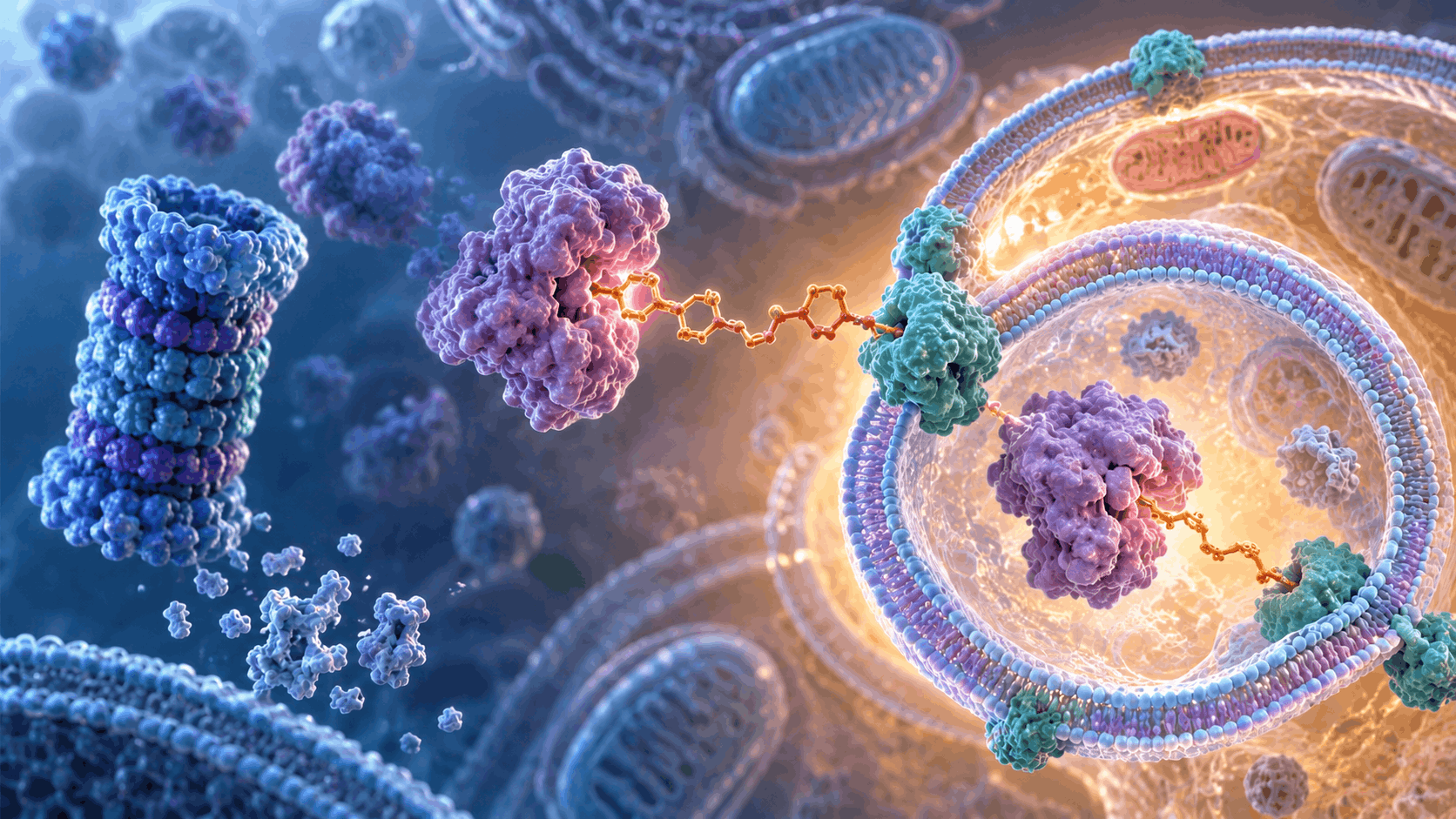
Autophagosome-tethering compounds, or ATTECs, are designed to engage both a target of interest and an LC3-family protein associated with autophagic membranes. By bringing those partners into proximity, an ATTEC can promote recruitment of selected cargo to phagophores or autophagosomes for subsequent lysosomal degradation. This distinguishes ATTEC from proteasome-directed strategies that recruit an E3 ubiquitin ligase and depend on ubiquitination.
The concept was established in Huntington disease models. A 2019 Nature study identified compounds that interacted with expanded polyglutamine mutant huntingtin (mHTT) and LC3, lowered mHTT while sparing wild-type HTT, and improved disease-relevant phenotypes in cell, fly, and mouse models. A 2024 EGFR study later reported LC3B-recruiting ATTECs that induced lysosomal-pathway-dependent EGFR degradation in non-small-cell lung cancer models, illustrating how the concept is being explored beyond polyglutamine proteins.
ATTEC Feasibility Is Target-Specific
ATTEC development is not simply a matter of connecting two ligands. Feasibility depends on identifying suitable binders for both the target and an LC3-family protein, achieving adequate intracellular exposure, preserving productive target-LC3 engagement, and confirming that degradation is dependent on autophagic flux. Target selectivity, degradation kinetics, cell-type dependence, and downstream biological effects should therefore be evaluated experimentally.
These requirements also make mechanistic controls important. A reduction in target abundance should be distinguished from nonspecific cytotoxicity or generalized autophagy activation, and candidate compounds should be evaluated with orthogonal assays that establish target engagement, degradation behavior, and pathway dependence.
Pathway Choice Becomes a Design Variable
ATTEC does not replace ubiquitin-proteasome-based degradation. Instead, it broadens the targeted protein degradation toolbox. A soluble protein with an available ligand, productive E3-ligase engagement, and a suitable cellular context may be well suited to proteasome-directed degradation. A target embedded in a complex, prone to aggregation, or otherwise compatible with autophagic handling may justify exploring an autophagy-directed strategy.
The more useful development question is therefore not which degradation technology is universally better, but which cellular pathway best matches the biology, localization, molecular state, and tractability of the target.
From Mechanism to Project Decisions
Creative Biolabs' ATTEC platform supports basic ATTEC design and screening together with in vitro and in vivo evaluation. Within its broader protein-degrader workflow, the company also offers ligand and linker design and optimization, target-degradation and cell-permeability assays, and in vivo ADME and toxicity studies. These capabilities can help project teams move from an initial target hypothesis toward compound optimization and preclinical evaluation without assuming that binding alone will translate into productive degradation.
Researchers evaluating whether an intracellular target is suitable for autophagy-directed degradation can explore Creative Biolabs' ATTEC platform or discuss a target-specific feasibility study with its scientific team.
As targeted degradation expands beyond the ubiquitin-proteasome system, ATTEC adds another route for interrogating disease-associated intracellular targets. Its value will ultimately depend on careful target selection, validated LC3 engagement, demonstrable autophagy dependence, and evidence that degradation produces the intended biological effect.
About Creative Biolabs
Creative Biolabs provides research services and products supporting targeted protein degradation and drug discovery. Its capabilities include ATTEC-based discovery, protein degrader molecule design, ligand and linker development, in vitro evaluation, and in vivo animal studies. Through these complementary platforms, the company supports academic, biotechnology, and pharmaceutical researchers investigating new approaches to disease-associated protein removal. Related products and services are intended for research use only.
Related Resources
• E3 Ligase Protein Resources
• Target Ligand Resources
• Protein Degrader Linkers